
We Bought Nicotine Pouches on Bui Vien for 300,000 VND
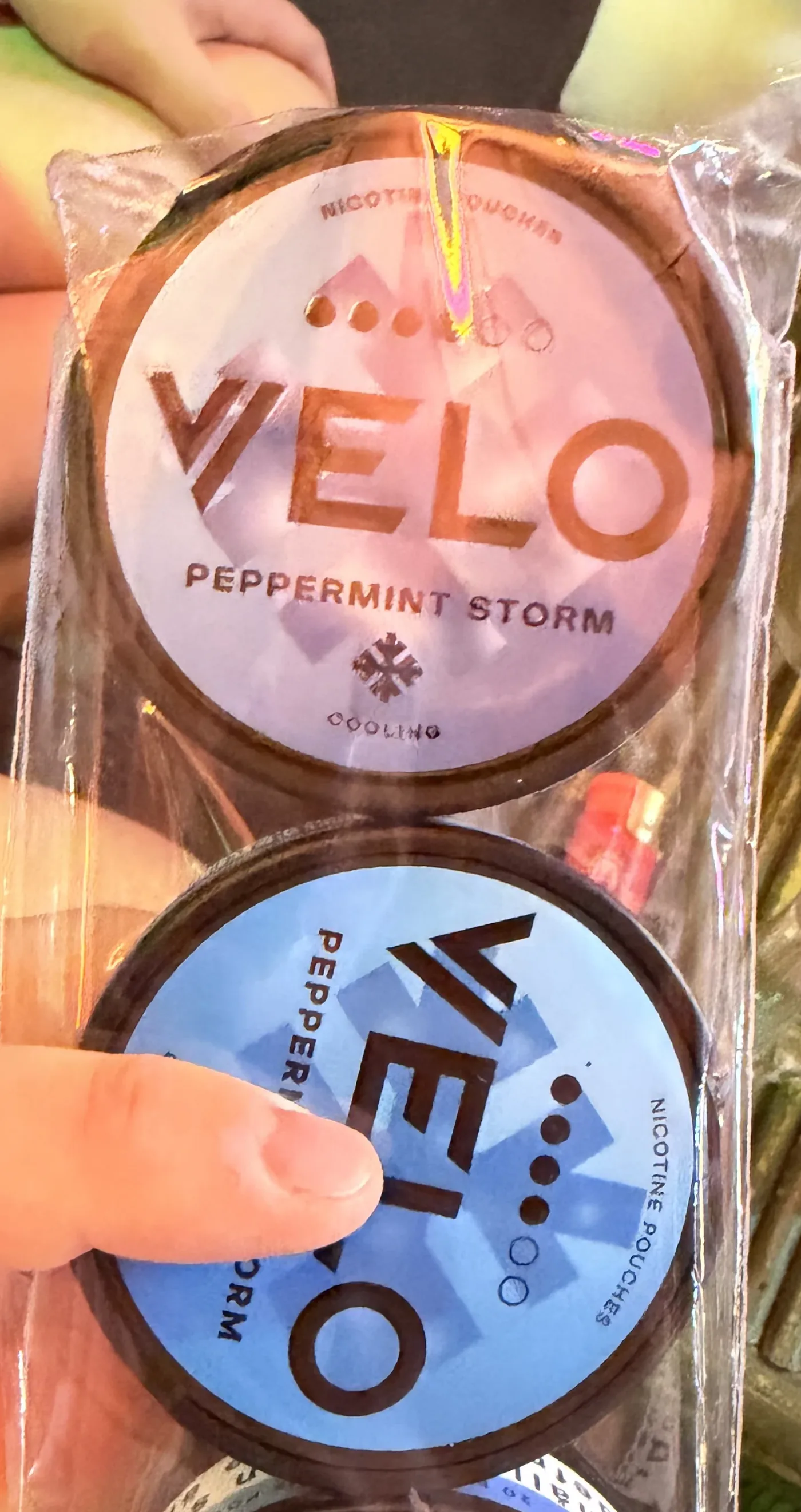
We bought nicotine pouches from a street cart on Bùi Viện for 300,000 VND, took them home, and photographed them. Two cans sealed inside the same plastic sleeve were manufactured three months apart. That single fact tells you the bundle was not assembled by the people who made the product, and it is the clearest thing in this article.
Before anything else: VinaPouches sells nicotine pouches. An article about how untrustworthy the competing supply is serves us commercially, and you should read it knowing that. So this page separates what the photographs prove from what we merely suspect, and it does not call anything counterfeit that we have not yet established is counterfeit.
Where they were on sale
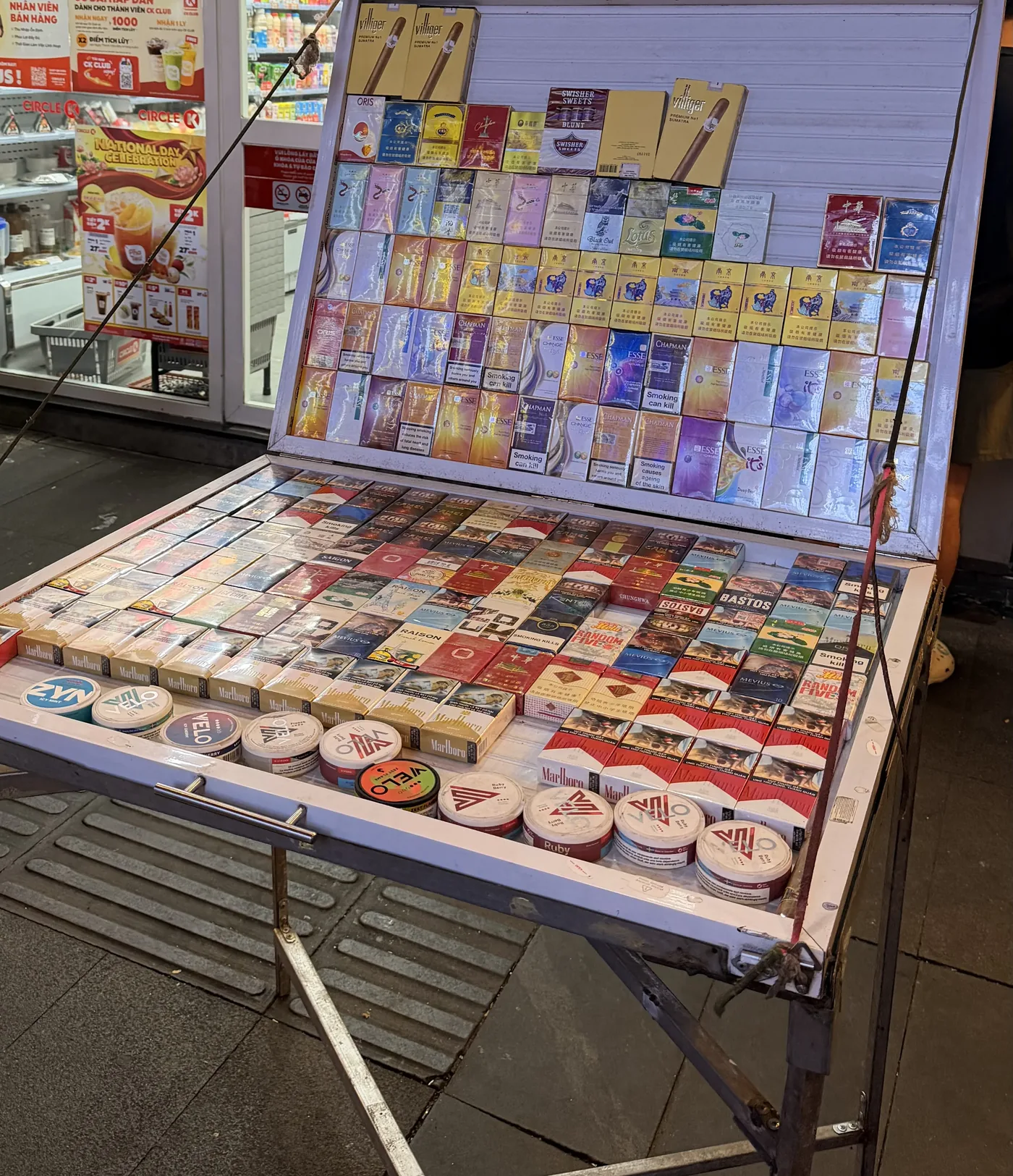
Not a shop. A folding glass case on a metal frame, on the pavement, open after dark. Cigarettes fill the board — Marlboro, Camel, Mevius, Raison, Esse, 555, Chunghwa, Bastos — and the nicotine pouches sit along the front shelf where a passer-by sees them first.
Nobody was asked for identification, and there is no mechanism on a cart like this by which anybody could be. That is worth stating plainly because the case for prohibiting these products in Viet Nam rests heavily on youth access, and this is what the current arrangement actually looks like at street level.
The thing that cannot be explained away
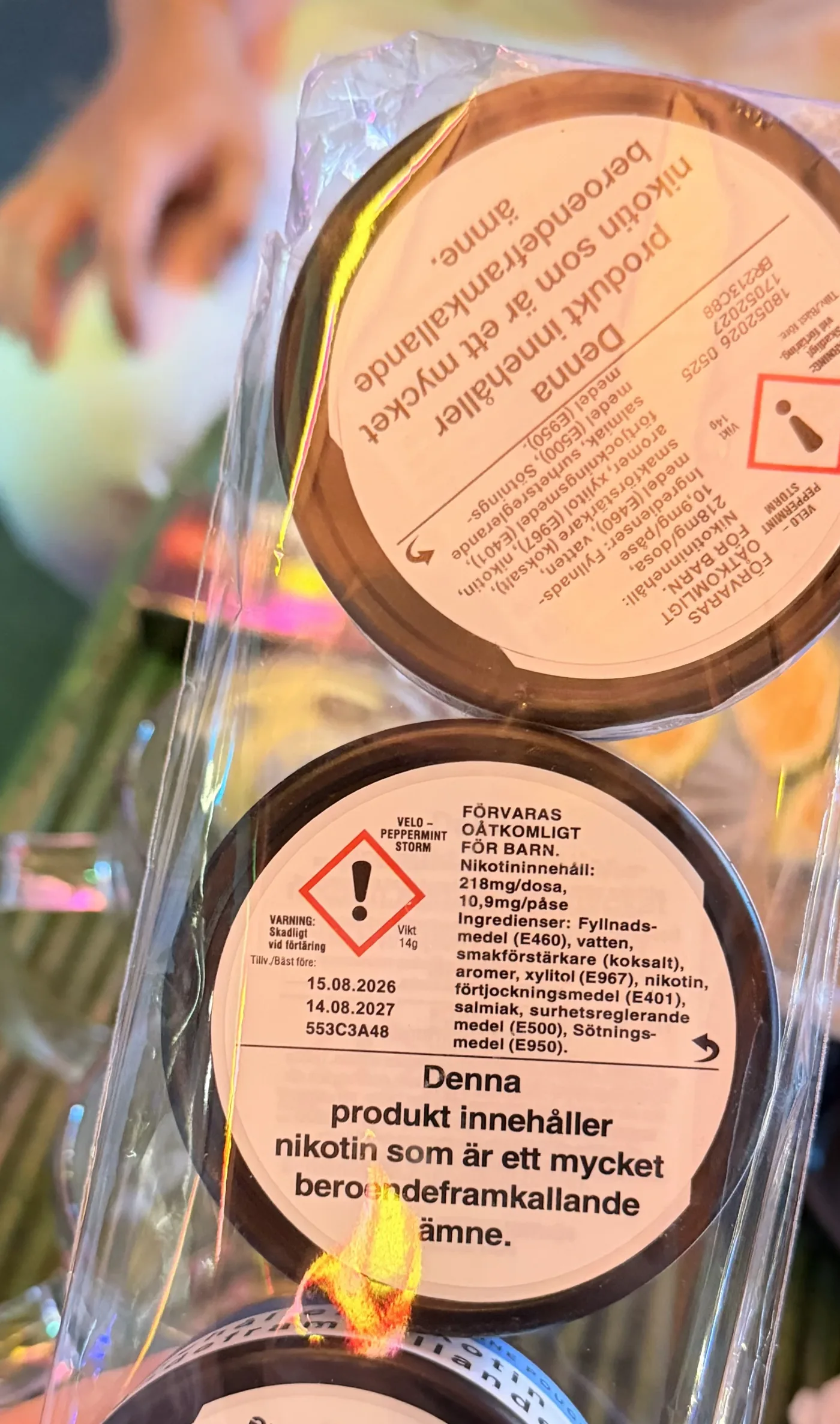
Read the two base labels. One says 15.08.2026 with a best-before of 14.08.2027 and the code 553C3A48. The other says 18.05.2026, best before 17.05.2027, code B8213C88.
Three months apart, different production runs, sealed together in one plastic sleeve and sold as a single unit. A manufacturer's multipack comes off one line on one day. Whatever else is true about these cans, somebody between the factory and the pavement opened the supply, mixed it, and re-wrapped it — and that somebody is not British American Tobacco.
The sleeve itself says the same thing more simply. It is unbranded clear plastic, heat-sealed at the ends. It carries no printing, no barcode and no brand.
One flavour, several faces, one shelf
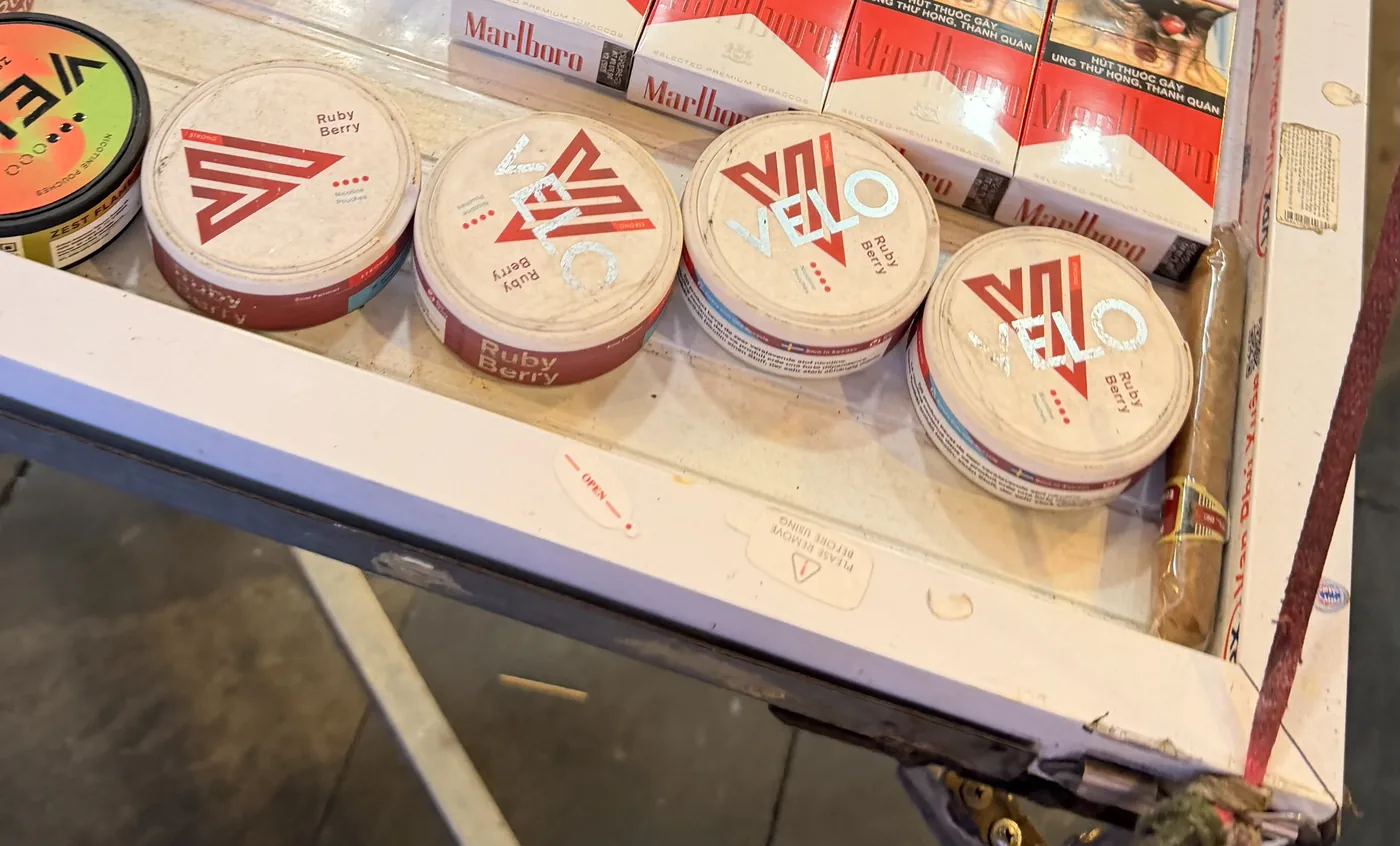
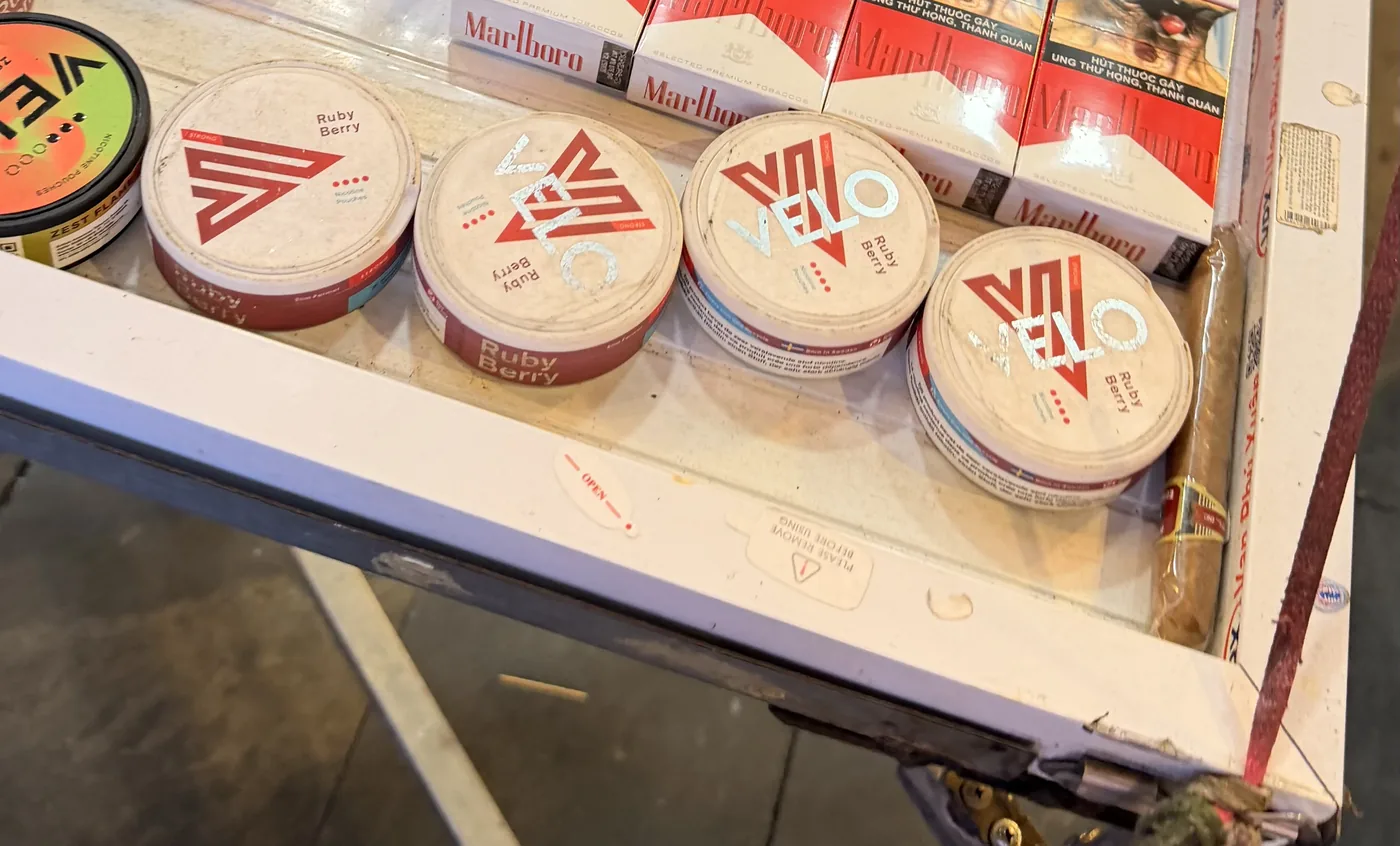
Four cans in a row on the cart, all labelled Ruby Berry, with visibly different logo treatments and layouts between them.
This one is suggestive rather than proof, and we will say so. VELO has changed its packaging design more than once, so a seller holding several generations at the same time has an innocent explanation: a shop sitting on slow-moving old stock looks exactly like this. We are including it because it is what the shelf looked like, not because it settles anything. The batch codes above do that work; this photograph does not.
Every can was labelled for Sweden
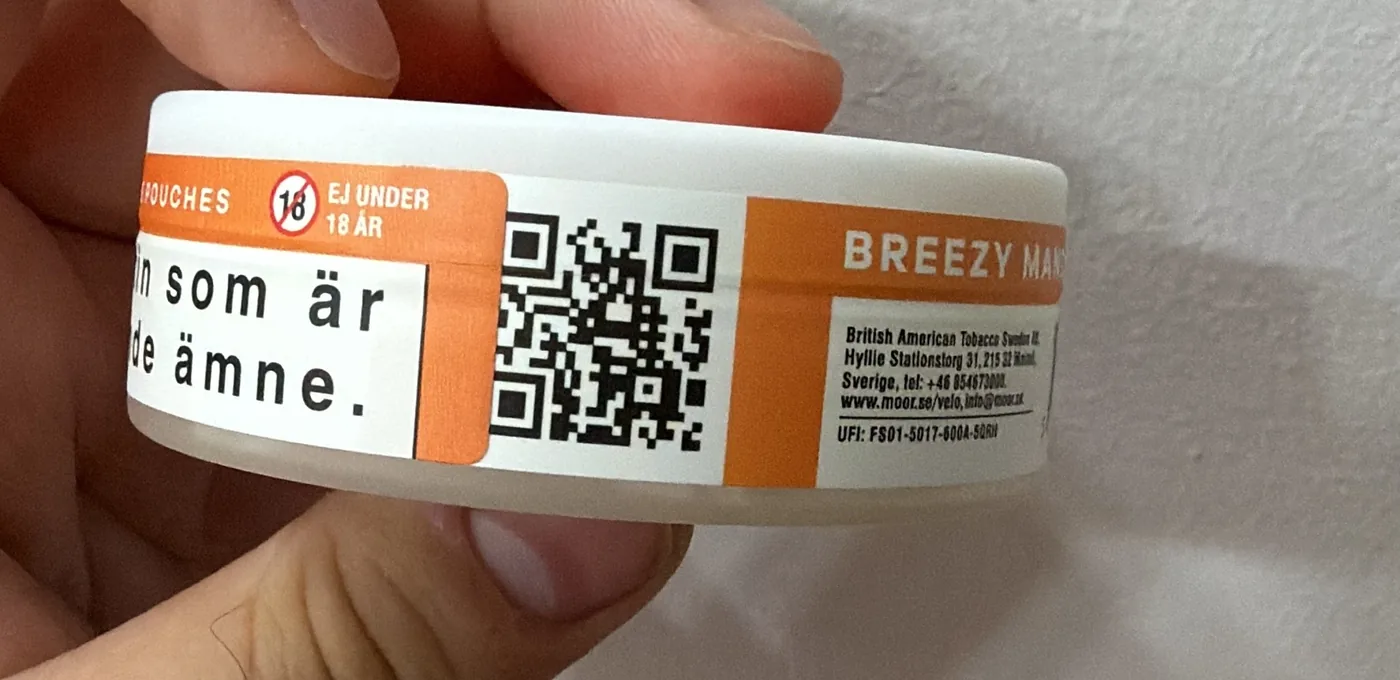
The wrap reads EJ UNDER 18 ÅR and carries a British American Tobacco Sverige address at Hyllie Stationstorg in Malmö, a QR code and a UFI code. The base labels are Swedish throughout: FÖRVARAS OÅTKOMLIGT FÖR BARN, keep out of reach of children; VARNING: Skadligt vid förtäring, harmful if swallowed; and the nicotine warning Swedish law requires, Denna produkt innehåller nikotin som är ett mycket beroendeframkallande ämne.
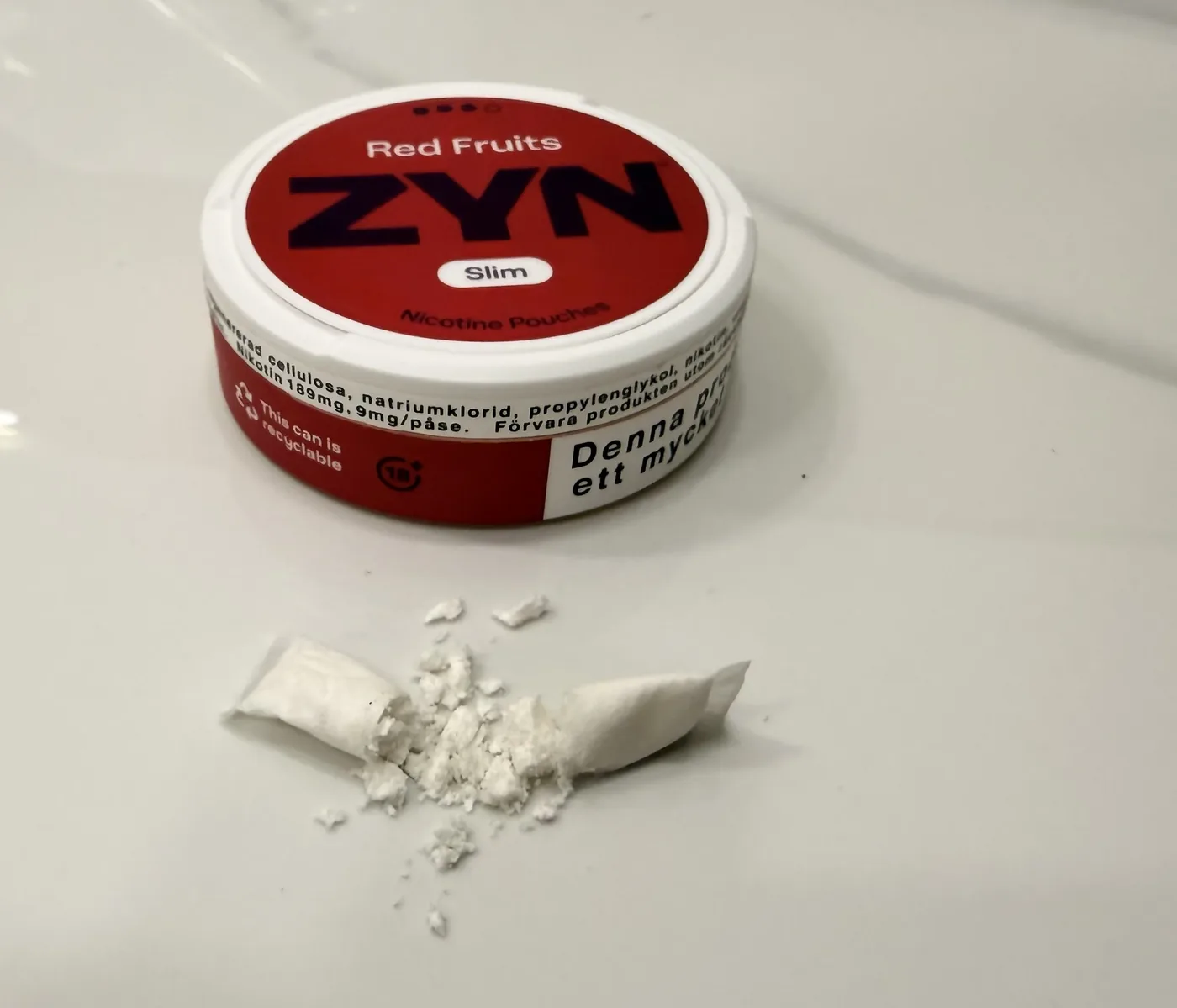
The declared figures are there too, in Swedish. The Peppermint Storm can states 218 mg per can and 10.9 mg per pouch, a 14 g net weight, and a full ingredient list down to the E numbers. A ZYN Red Fruits Slim can from the same trip states 189 mg per can and 9 mg per pouch.
Not one word on any can was in Vietnamese. No importer, no local distributor, no Vietnamese-language warning, nothing a buyer here could act on. One can carried a comparative claim printed in English that would not be permitted on packaging in a number of the markets these cans passed through.
Whatever these cans are, they did not reach that pavement through a channel anyone would describe as authorised.
What the seller told us, and why it settles the question
We asked one of the sellers in District 1 what they pay for a can. The answer was 20,000 VND, delivered to them by a Chinese man who supplies the carts.
That is one conversation with one seller and we cannot corroborate it. But the number is checkable against something we can document, because we import the genuine article ourselves. Here is our own supplier invoice from August 2026, EXW from a European distributor, against what the street pays.
| Per can | Price | Approx. VND |
|---|---|---|
| Street cost to the seller, District 1 | — | 20,000 ₫ |
| Genuine VELO, European wholesale, our invoice | €2.79 | ~78,000 ₫ |
| Genuine ZYN, same invoice | €2.70 | ~76,000 ₫ |
| Genuine XQS, same invoice | €2.68 | ~75,000 ₫ |
The street pays about a quarter of what a European wholesale buyer pays, and that is the comparison at its most generous, because the wholesale column is the price before anything else happens to it. It is EXW: before freight from Sweden, before the customs declaration fee, before the brokerage surcharge, before duty, excise and VAT. Our own shipment is sitting in a bonded warehouse in Ho Chi Minh City accumulating exactly those costs as we write this.
So the question is not really whether these cans are counterfeit. It is whether anyone could buy genuine VELO in Europe at €2.79, fly it to Viet Nam, clear it through customs, and hand it to a pavement vendor at 20,000 VND. Nobody can. The arithmetic forecloses it before the packaging evidence is even considered.
This is why we are willing to be blunt about the street trade in a way we are not about any individual can. Nicotine pouches sold from carts in Ho Chi Minh City at these prices are not parallel imports of genuine stock, because genuine stock cannot reach that price. Whatever is in them, it did not come from Malmö.
Where this supply actually comes from
The seller's account of a Chinese supplier is a single unverified remark, but it is consistent with what Chinese authorities have themselves been publishing.
In Guangdong, police dismantled an illegal nicotine pouch operation with a case value over 100 million yuan, roughly 14 million US dollars, involving suspected counterfeits of VELO, ZYN and PABLO. In Bao'an, Shenzhen, investigators seized more than 800,000 boxes from a nicotine pouch production company, including counterfeits carrying ZYN and VELO branding. China Customs separately seized over 265,000 oral nicotine pouches flagged for trademark infringement. In May 2026 US Customs and Border Protection seized more than 18 million units of unauthorised nicotine products shipped from China, with a retail value above 175 million dollars.
One detail from that reporting explains almost everything we photographed. Some of these operations sell white-label cans: unbranded product that the buyer labels themselves with whatever brand they choose. That is the mechanism behind a shelf carrying one flavour name on several different label designs, behind cans of the same flavour with unrelated batch codes bundled together, and behind a supply chain in which a can can wear a Malmö address without ever having been near Sweden.
ZYN is a frequent target for counterfeiters, which follows from it being a name many buyers already know. The counterfeiter's target is whatever the buyer already trusts.
The flavour-name test, and where it fails
The easiest tell on a counterfeit is a flavour the manufacturer never made. Names like Cola Ice, Banana Milkshake, Gummy Bear, Strawberry Cake, Lychee Ice, Pineapple Coconut and Forest Berry turn up on cans wearing ZYN branding. They are not part of the European range. We carry 42 ZYN lines and not one of those names appears among them.
| Flavour name | Verdict | Strengths we carry |
|---|---|---|
| Cola Ice | Counterfeit | — |
| Banana Milkshake | Counterfeit | — |
| Gummy Bear | Counterfeit | — |
| Strawberry Cake | Counterfeit | — |
| Lychee Ice | Counterfeit | — |
| Pineapple Coconut | Counterfeit | — |
| Forest Berry | Counterfeit | — |
| Watermelon Strawberry | Counterfeit | — |
| Watermelon Mint | Genuine European line | S2 |
| Cactus Spice | Genuine European line | S3, S4 |
| Red Berry Fizz | Genuine European line | S2, S3, S4 |
| Blueberry Mint | Genuine European line | S4 |
| Menthol Ice | Genuine European line | S4, S5, S6 |
| Gentle Mint | Genuine European line | Mini S1, Slim S2 |
| Violet Licorice | Genuine European line | S2, S3 |
| Black Licorice | Genuine European line | Mini S2 |
| Peach | Genuine European line | Mini S2 |
| Coffee | Genuine European line | Mini S2, Mini S4 |
The logic on the top eight is simple. ZYN does not make those flavours, so a can wearing ZYN branding and one of those names was not filled by ZYN. None of the eight appears anywhere in the 42 ZYN lines we import, and the naming is the giveaway: dessert and confectionery names read as approachable to somebody who has never tried a pouch, which is exactly the buyer a counterfeiter is looking for.
The ten below them are why you should not memorise a list. Every one is a genuine European line that we import and sell, and every one is routinely missing from the "official ZYN flavours" lists circulating online, because those lists are usually the American range with a few European names bolted on. A buyer checking against one of them rejects real product and feels clever for doing it.
Look at the two watermelon rows. Watermelon Mint is real, it is a 2026 addition to the European range, and we stock it at S2. Watermelon Strawberry is not a ZYN flavour at all. Nobody holds that distinction in their head at a cart at eleven at night, and the newest genuine flavours are precisely the ones missing from every list you could check against.
So the flavour name is a useful first flag, not a verdict. If a name sounds like a dessert, slow down. Then check the exact wording against a seller who publishes a full catalogue you can search, rather than against a list somebody assembled for a different market. Our full ZYN range, including what the S numbers on a European can actually mean, is set out separately.
What we cannot tell you yet
We can photograph a sleeve, a date code and a label. We cannot photograph nicotine content, and that is the part that matters. A can can be repackaged and still hold exactly what the label claims. It can also hold a third of it, or three times it.
So we tried to have them analysed, and that is where this account currently stops.
We approached commercial laboratories in Ho Chi Minh City with a defined panel — nicotine content per pouch, pH and free nicotine, heavy metals by ICP-MS, tobacco-specific nitrosamines, and microbiology — offering sealed genuine cans of the same brands and flavours as matched controls, which is the ordinary way to run a comparison. None of them took the work. One replied that it was unable to support the requested analysis. The others did not take it up at all.
That refusal is itself a finding, and it belongs in this article more than the results would have. A product is sold openly on the pavement in District 1. A buyer who wants to know what is inside it cannot find a laboratory in the country willing to tell them. There is no verification infrastructure here, which means the only people who know what is in these cans are the people who filled them.
It also puts the proposed prohibition in an awkward light. The case for banning nicotine pouches in Viet Nam rests on what they contain and who they reach. Neither of those questions can currently be answered domestically, by us or by anyone else.
We are now arranging analysis outside Viet Nam, at a laboratory that tests nicotine products as its ordinary business and works to the CORESTA methods written for this category. We will publish what comes back, including if it matches the label exactly. A test you only report when it suits you is not a test.
What this means if you are buying
The specific tell that first caught our attention was the seal: the cans we handled carried a doubled sticker where genuine stock we hold carries a single one. We are photographing that properly before we describe it as a rule, because a detail like that is only useful if it is precise.
The general position needs no laboratory at all. Genuine stock cannot reach a pavement cart at 20,000 VND a can, so what is on those carts is not genuine stock that took an unusual route. It is something else, produced by people whose business model is that you cannot tell the difference, sold by a vendor who has no way of knowing either and no address at which to answer for it next week.
Our two existing guides cover the checks you can run with a can in your hand in about thirty seconds — the barcode, the batch code, the seal, the print, the price. This page is the field evidence behind them.